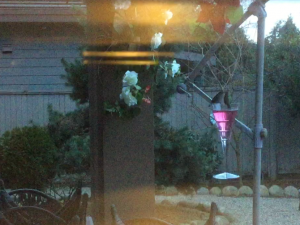
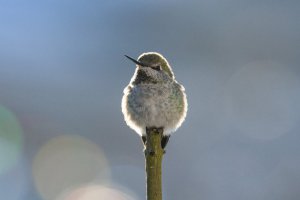
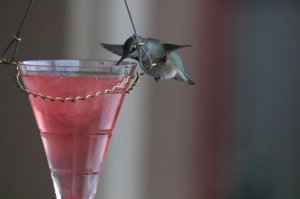
许多蜂鸟有迁徙习惯,来我家的蜂鸟叫朱紅蜂鸟(Calypte anna ),它不迁徙一年四季可见它的踪影
详细信息请看下面的英文:
Anna’s Hummingbird (Calypte anna)
Anna’s hummingbirds lives along the west coast of North America, and is fairly common in California (the picture was taken in Palm Springs). They live in woods, gardens, and parks, pretty much anywhere they can get a ready supply of nectar. For hummingbirds, Anna’s hummingbirds are medium sized (which is tiny compared to most birds). They are about ten centimetres long, and are mostly grey/green, with males having a bright red head and neck.
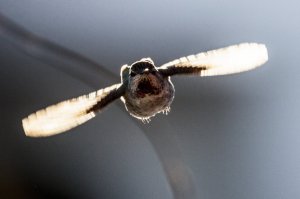
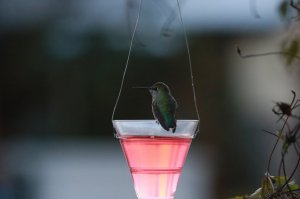
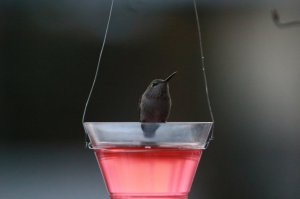
Like most hummingbirds, Anna’s hummingbird feeds largely on nectar. This energy rich food source is critical to sustain the hummingbird’s ridiculously busy lifestyle (hummingbirds have to beat their wings 12-80 times per second to hover). Hummingbirds hover in front of flowers and stick their their tongue into them, extracting the nectar. Unfortunately for Anna’s hummingbird, nectar is pretty much just sugar water, so they need to eat some other things to get the protein and nutrients they need. They often eat small insects, opening their long beaks wide to scoop them up mid-flight. They also eat tree sap, sticking their silly long beak into tree holes to extract it.
The main nutritional problem that a hummingbird faces is getting enough energy. They are so active that they constantly need nectar to keep themselves going. At night, this becomes difficult because the bird can’t really see and locate flowers. The hummingbird’s solution is to enter a state of torpor at night. Torpor is basically a shorter and less severe version of hibernation. The hummingbird slows down its basal metabolic rate to consume less energy, and wakes up once the sun has warmed its body in the morning.
Anna’s hummingbirds are sexually dimorphic, with males sporting a bright red iridescent crown on their heads. Each hummingbird has their own territory which they defend vigorously from any invaders. Once the breeding season starts, females enter a male’s territory, and he performs a courtship ritual consisting of a multitude of dives. The female lays her eggs in a nest she build out of spider silk, plants, feathers and hair. She lays 2 eggs, which hatch in two weeks. The mother provides all parental care in Anna’s hummingbird; presumably after he does his business with her he flies off in search of another lucky lady.
Hummingbirds are really neat little birds; they’re so fun to watch flitting from one flower to another. I was proud to be a hummingbird in elementary school, and my fascination with the animal has not waned.
This hummer is a familiar species in West Coast gardens, where it is present year-round. Monotypic. Length 3.5–4" (9–10 cm); bill 16–20 mm
Identification Tail slightly rounded to double-rounded. Adult male: rose (fresh) to orange-red (worn) gorget and crown. Adult female: throat and underparts spotted and mottled dusky to bronzy green, median throat blotched rose-red. Immature male: resembles adult female but upperparts fresher in February to June, with fine buff tips; throat and crown usually with more scattered rose spots; white tail tips narrower. Complete summer molt produces plumage like adult male by late fall. Immature female: resembles adult female but upperparts fresher in February to June; throat often lacks rose spots.


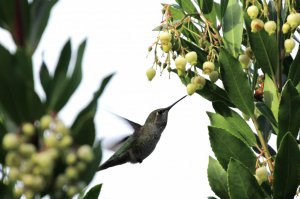


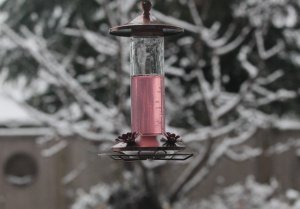

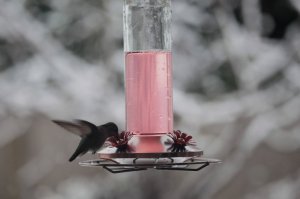















 。 我家的佳能估计也拍不出来楼主的效果。。。


 恭喜
恭喜