The Lifesaving Society is a charitable organization working to prevent drowning and water-related injury through our training programs, Water Smart� public education, safety management services, drowning prevention research and lifesaving sport.
The Lifesaving Society is a charitable organization working to prevent drowning and water-related injury through our training programs, Water Smart� public education, safety management services, drowning prevention research and lifesaving sport.
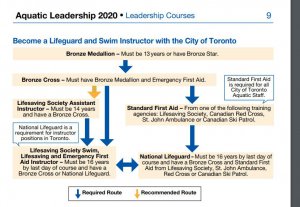
CPR-C/aed 是最基本要求,有的还要求CPR-HCP,然后再符合三楼的流程,就齐活儿了
另外补充一个 Bronze cross 发证概述/要求 Bronze Cross (18-20 hr.): Designed for lifesavers who want the challenge of more advanced training including an introduction to safe supervision in aquatic facilities. Bronze Cross is a prerequisite for all advanced training programs including National Lifeguard and Instructor certification. Includes a timed 600 m swim.
Bronze Cross is recognized as an assistant lifeguard certificate in Ontario Regulation 565 governing public swimming pools.
具体科目
AT-A-GLANCE
*Starting on a deck, dock, or beach, demonstrate an entry and swim a 50 m or yd. head-up approach with a shoulder loop and line or rescue tube to a passive victim or manikin, and then tow the victim 50 m or yd. to safety.
*Swim head-up for two sets of 6 x 25 m or yd. while maintaining a consistent pace and work-to-rest ratio. Rest for 1 minute between sets. Check your pulse after the last repeat in each set.
*Swim 600 m or 650 yd. in 18 minutes or better using any combination of strokes of the candidate's choice.
*Demonstrate primary assessment of a conscious victim and an unconscious victim, including:
Level of consciousness
Airway
Breathing
Circulation
Major bleeding
Mechanism of injury
Demonstrate secondary assessment of a victim, including:
Vital signs
Head-to-toe survey
History
*Demonstrate rescue breathing and cardiopulmonary resuscitation (CPR) on a manikin, including:
Adult, child, and infant victims
Complications in resuscitation (e.g., vomiting)
Adaptations (e.g., mouth-to-nose, stoma)
*Demonstrate two-rescuer adult, child, and infant cardiopulmonary resuscitation (CPR) on a manikin.
*a) Simulate the treatment of a conscious adult or child with an obstructed airway. *b) On a manikin, demonstrate the treatment of a conscious infant with an obstructed airway. *c) Simulate the treatment of an unwitnessed unconscious adult, child, or infant with an unobstructed airway.
*Demonstrate the care and treatment of a victim suffering from hypothermia.
*Walk an aquatic environment scene, evaluate the ongoing activities, and demonstrate how to educate peers about safe aquatic leisure choices. Evaluate and correct, where appropriate, hazardous conditions in unsupervised areas.
Recover and immobilize a face-down breathing victim with a suspected cervical spinal injury found in deep water. Transport to shallow water. Recruit and direct a trained bystander to assist. Demonstrate the ability to manage vomiting while maintaining immobilization.
*Using bystanders, organize a logical underwater search of an area with both shallow and deep water to maximum depth of 3 metres.
Perform a rescue involving two or more victims. One victim requires rescuer assistance, while the other victim(s) can follow directions for self-rescue and assist as bystanders once at the point of safety. The situation is designed to emphasize communication skills, victim care, removals, and follow-up including contact with EMS.
Perform a rescue of a submerged, non-breathing, and pulseless victim. The situation is designed to emphasize victim care, removal, and follow-up including contact with EMS.
*Perform a rescue of an injured victim in a situation in which there are two rescuers. The rescue requires a 50 m or yd. approach and a 50 m or yd. return. The situation is designed to emphasize either contact or non-contact rescues, victim care, removals, and follow-up including contact with EMS.
Perform a rescue of a victim suffering injuries or conditions in a situation that emphasizes rescuer response to deteriorating circumstances and requires the use of bystanders. The rescue requires a 20 m or yd. approach and a 20 m or yd. return.