回复: 加国独立屋的承重?
According to BS6399-1, 1996 (Loading for buildings) a residential structure should be designed for a distributed load of 1.5kN/m2, and a point load of 1.4kN.
1 NEWTON is the force required to give a mass of 1KG an acceleration of 1m/s/s (1m/s2)
1NEWTON = 1KG*(M/S2)
F=MA
If the acceleration is due to gravity then
F=M*9.81m/s2
1.5KN=M*9.81
1.5*1000=M*9.81
M=1500/9.81=153KG
If the room is 2.13m*2.13m then the maximum weight allowed is
Max Weight =Area*153KG
Max Weight =2.1*2.1*153
Max Weight =4.41*153
Max Weight =674kg (uniformly distributed over the whole area!)
If the room is 2.1m*3.2m then the maximum weight allowed is
Max Weight =Area*153KG
Max Weight =2.1*3.2*153
Max Weight =6.72*153
Max Weight =1028kg (uniformly distributed over the whole area!)
mill weighs 300kg
lathe weighs 200kg
total weight = 500kg
the 500kg weight must be distributed over an area, so that the 1.5KN/m2 loading is not exceeded.
the 500kg weight must be distributed over an area, so that the 153kg/m2 loading is not exceeded.
hence
Area=500/153
Area=3.27m2
the 500kg load must be uniformally spread over a 3.27m2 area
say we will build a small wooden dias, that will be used to distribute the load
if the width of the room is 2.1m then the length of the dias should be 3.27/2.1=1.56m
hence a dias of 2.1m*1.56m will distribute the load over a 3.27m2 area.
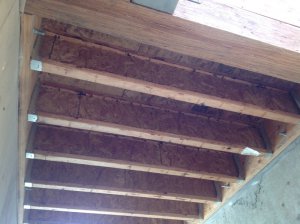
best keep the loads close to the ends of the joists that bear on the supporting wall.
--5 号大字推荐了一种对付局部承载超限的方法.



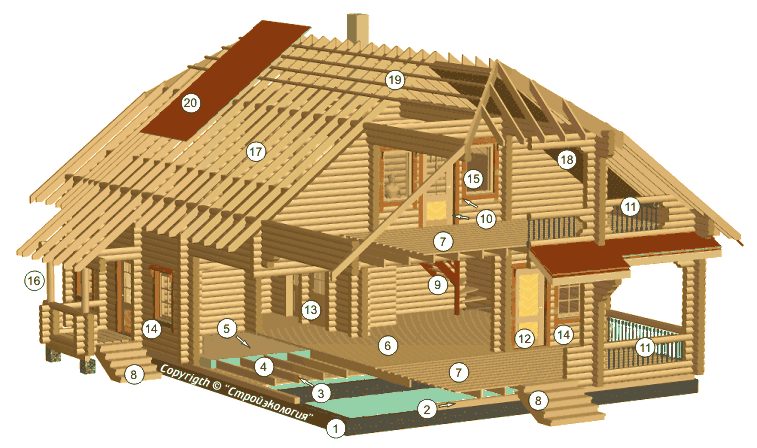


 我我我是真的担心。。。国内的钢筋水泥质量不过关,这边觉得质量应该没问题,但是木头房子我还是很担心啊,走路踩重点整个地板都颤悠。。。我也不是很胖啊。。。